
Research Projects
My research interests primarily include observational studies of distant galaxies, active galactic nuclei (AGN), and the supermassive black holes at their centers. I am also interested in theoretical research, and I have participated in various projects that utilize numerical simulations and high-performance computing frameworks to model other astronomical objects like protoplanetary disks, pulsars in globular clusters, and white dwarfs. I am very curious about how these tools can be implemented to complement observational studies of galaxies and AGN and improve our understanding of their underlying physical processes.
Read more about selected projects below!
Searching for Little Red Dots at z < 4
Little red dots (LRDs) are a mysterious population of compact, red objects that were just recently discovered by the James Webb Space Telescope (JWST). They are most prevalent in the early universe (4 < z < 8), and studies using JWST data have shown that the population of LRDs appears to dramatically decline at later times (z < 4). However, JWST data is very narrow and deep, so wider surveys that can probe a larger area of the sky are needed to truly understand this population of rare objects. Therefore, in my project I have conducted a search for late universe LRDs (z = 1.5 - 4) using the Cosmic Dawn Survey, which includes imaging from several ground-based
telescopes, the Spitzer Space Telescope’s Infrared Array Camera (IRAC), and recently also the Euclid Space Telescope. I have identified more than 30,000 photometric LRD candidates, over 300 of which also have rest-frame ultraviolet spectroscopic coverage from the Hobby-Eberly Telescope. We are working on using completeness correction simulations to estimate the number density of LRDs at these redshifts and constrain how rapidly their population declines. We have proposed to use multiple world-class telescopes, including JWST and the Keck Telescope, to conduct follow-up observations of our spectroscopically-confirmed sample. This work was conducted as part of the Vertically Integrated Projects: Galaxy Evolution group with Dr. Steven Finkelstein at UT Austin, and we are currently working on publishing our results in a paper.
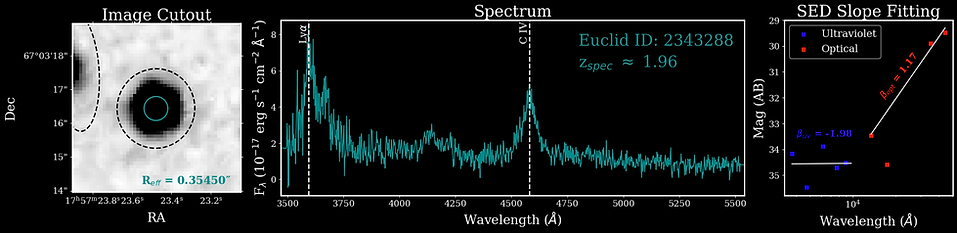
Shown above are several of our high-confidence LRD candidates
Simulating Pulsars in Globular Clusters
Pulsars are dense remnants of collapsed massive stars that rotate rapidly, so fast in fact that a subset of these are known as millisecond pulsars (MSPs) (with rotation periods between 1 and 30 ms). Unlike the Galactic field, a vast majority of the pulsars in globular clusters (GCs), or spherical concentrations of stars bound together, are MSPs. The underlying populations of MSPs residing across the Milky Way's globular cluster (GC) system provide important clues to our understanding of neutron star formation and evolution in these dense stellar environments. Therefore, using properties of a sample of known Galactic GCs and constraints on their diffuse fluxes from the Fermi Gamma-Ray Space Telescope, we
developed Monte Carlo simulations to estimate the number of MSPs in a sample of Galactic GCs. We used two different gamma-ray luminosity models for comparison, and we found that a lognormal model provides the best agreement with observations. We also used our models to estimate the number of radio pulsars beaming towards us in each GC by positing that the radio emission scales with that seen in gamma-rays. Our results imply that a singular model can jointly constrain both the gamma-ray and radio populations of MSPs in GCs. This work was supported by the West Virginia University REU under the advising of Dr. Duncan Lorimer, and we have submitted our paper to the Journal of High Energy Astrophysics. The preprint is available for viewing here: Gamma-ray and radio populations of millisecond pulsars in globular clusters.


Left: Hubble image of a globular cluster. Right: Predictions for the number of MSPs across a sample of 118 Galactic GCs using a lognormal gamma-ray luminosity model.
Hydrodynamic Simulations of Protoplanetary Disks
Observations of protoplanetary disks (PPDs) from the Atacama Large Millimeter Array (ALMA) have revealed that these objects made of 99% gas and 1% dust are not just uniform disks, but they are actually rich with substructures. The goal of this project was to better understand how ring-type substructures in these disks
form, which are typically explained by invoking giant planets. However, non-planetary origins like disk instabilities may also be possible, so I simulated one in particular called the ‘irradiation instability’ using the astrophysical fluid dynamics code, Athena++, and a simplified model for radiative transfer. I replicated and extended previous simulations to the outer disk, and added a preliminary model to correct the opacity in regions where low gas density causes the dust to settle quickly. This work was supported by the Northern Arizona University REU under the advising of Dr. Taylor Kutra from Lowell Observatory.


Shown in each pair above are comparisons between observations from the ALMA DSHARP data release (left) and models of protoplanetary disks from Athena++ (right). The left model shows the formation of a ring-type substructure using the irradiation instability, and the right model shows the formation of an arc substructure using the rossby wave instability.